Kyrgyzstan secures first UN Security Council non-permanent seat as Germany suffers historic setback
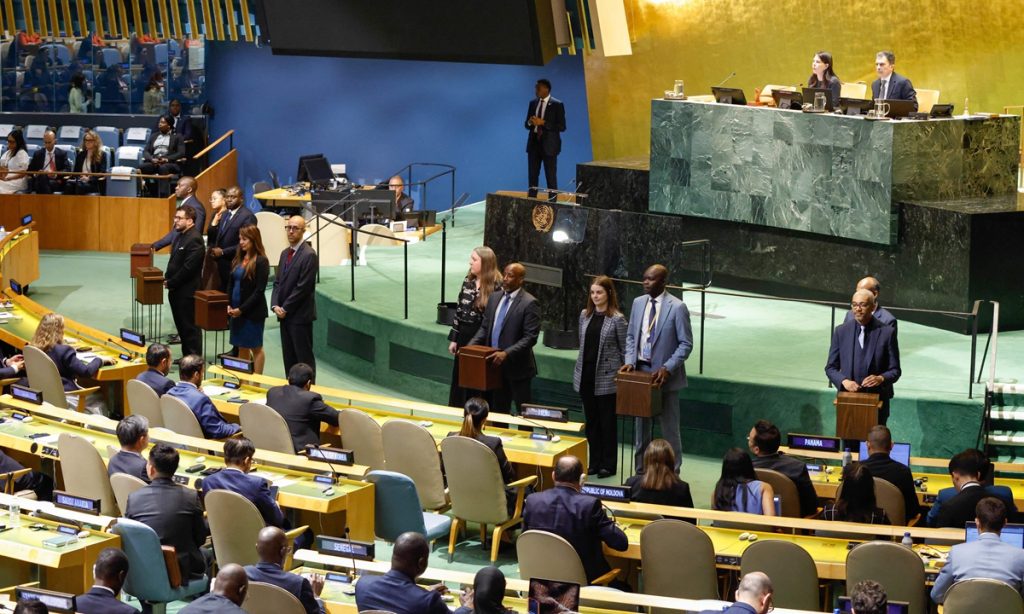
A closely watched United Nations (UN) Security Council election delivered a mix of continuity and change on local time Wednesday, as Austria, Portugal, Trinidad and Tobago, Zimbabwe, and first-time member Kyrgyzstan secured seats as non-permanent member of the Security Council, while Germany suffered a notable setback, according to UN News.

The election came against the backdrop of widening geopolitical divisions and repeated deadlock within the UN body in resolving conflicts and preventing wars. The five countries were elected by the 193-member General Assembly to serve as non-permanent members of the Security Council for two-year terms beginning on January 1, 2027.

Austria and Portugal won the two seats allocated to the Western European and other States Group, while Trinidad and Tobago was elected from the Latin American and Caribbean Group and Zimbabwe from the African Group.

Kyrgyzstan secured the Asia-Pacific seat after defeating the Philippines in four rounds of voting. Germany, however, suffered what the media refers to as "a historic defeat" in the election, breaking its winning streak.

The Security Council has 15 members: five permanent members with veto power - China, France, Russia, the UK and the US - and 10 non-permanent members elected by the General Assembly for staggered two-year terms.

Bahrain, Colombia, the Democratic Republic of the Congo, Latvia and Liberia will remain on the Council through the end of 2027, providing continuity in its work.

The Security Council has the authority to impose sanctions, authorize peacekeeping missions, establish international tribunals and, in exceptional circumstances, authorize the use of force.

Although non-permanent members of the UN Security Council do not possess veto power, they can directly participate in the deliberation, voting, and agenda-shaping of issues concerning international peace and security. Their institutional influence should not be underestimated, Gao Wanni, the deputy dean of the School of Politics and International Relations at Lanzhou University, told the Global Times on Thursday.

Chen Hong, director of the Asia-Pacific Studies Center at East China Normal University, told the Global Times the election outcome reflects the UN member states' response to the principles of geographical balance, fair representation, and the broader trend toward a multipolar world.

Making history

One of the most dramatic and striking moment of the Wednesday election was the win for Kyrgyzstan. This marked not only a major diplomatic breakthrough for Bishkek, but also the return of Central Asian representation to the Security Council for the first time in nearly a decade, following Kazakhstan's 2017-2018 term, according to the UN official news site release and Central Asian media reports.

"A Truly Historic Moment! Thank You for Your Trust!" the Ministry of Foreign Affairs of Kyrgyzstan wrote in a post on X, attaching a video of the announcement of the final round of voting where Kyrgyzstan defeated the Philippines. In the final round, 142 countries voted in favor of Kyrgyzstan, a two-thirds majority.

After the victory, Kyrgyzstan's Foreign Minister Jeenbek Kulubayev told reporters "we understand now is a turbulent time" and said Kyrgyzstan will work together with other council members, the AP reported on Thursday.

The Philippine local media Inquier.net covered the close contest between the two countries while highlighting that "Kyrgyzstan is among 59 UN member states that have never served on the Security Council."

According to the Philippine News Agency, Malacanang presidential palace on Thursday said domestic political tensions may have contributed to the Philippines' unsuccessful bid for a non-permanent seat in the UN Security Council.

Pass Blue, an independent, US-based digital publication that monitors and reports on activities by the UN, reported on Wednesday that Kyrgyzstan campaigned on a commitment to the UN Charter, multilateralism and conflict prevention. The permanent representative, Aida Kasymalieva, described the race as a milestone in the country's post-independence development.

"This is not only about a seat," she said during a World Federation of United Nations Associations (WFUNA) session on May 20. "It's about the completion of a long chapter of state-building, democratic transition, national consolidation, and international engagement."

Kyrgyzstan's election reflects a deeper demand for representation. Among UN member states, there are numerous landlocked small and medium-sized countries like Kyrgyzstan, yet they have long remained on the margins of the Security Council agenda. In this election, a country that has never held a Security Council seat before defeated the Philippines — which possesses a stronger traditional diplomatic network — by a wide margin of 142 votes to 49. This in itself is a clear signal, Gao said.

The victory also carries broader regional significance. Central Asia sits at the intersection of several issues regularly discussed at the Security Council, including counterterrorism, water security, transnational crime and regional stability. Kyrgyzstan's term is expected to give the region a more direct platform in Council deliberations, the Times of Central Asia report noted.

Bitter defeat

Western media services such as Reuters emphasized more over the fallout of Germany, stating that Germany, which had lobbied hard for a seat, came third for the two places contested by the Western European and Others Group, with 104 votes, against 134 for Portugal and 131 for Austria.

Germany's leading role in rallying support for Ukraine and its close relations with Israel may have cost Berlin the chance of a seat ‌on the UN Security Council, German Foreign Minister Johann Wadephul said on Wednesday, Reuters reported in another report on Wednesday.

Speaking to the press after the vote, Wadephul called the outcome "a real disappointment." German Chancellor Friedrich Merz said: "We applied with conviction. We did not achieve our goal," local media DW reported.

According to RFI, this marks Germany's seventh bid for a non-permanent UN Security Council seat and its first-ever defeat. As Europe's largest economy, a G7 member and one of the major UN contributors, Germany had won all six previous campaigns.

DW noted that Germany is the second-largest contributor to the UN. The DW report also said that Wadephul, who had traveled to the UN in New York for the occasion, told the press afterwards that Germany's positions on the wars in Ukraine and Gaza may have influenced how states voted.

"It also may have cost us votes that Germany must always assume a special responsibility to Israel with regard to the Middle East conflict," Wadephul said.

Euronews wrote that diplomatic circles also viewed critically the fact that the German federal government had failed to clearly describe either the US or the Israeli attacks on Iran as violations of international law. Observers saw this as a potential handicap for the candidacy.

The Times headlined its report "Germany suffers historic UN Security Council defeat." A loss to Austria denies Berlin a seat, breaking a winning streak in the periodic ballots, per the Times.

Germany has been a non-permanent member of the Security Council six times to date: 1977/1978, 1987/1988, 1995/1996, 2003/2004, 2011/2012 and 2019/2020, per the federal government.

The defeats of Germany and the Philippines — both close US allies — show reliance on US-style alliances and bloc confrontation is no longer widely supported by the international community, Li Haidong, a professor at China Foreign Affairs University, told the Global Times on Thursday.

Through unilateral measures such as slashing UN funding, successively withdrawing from multilateral mechanisms, and selectively engaging in international affairs, the US has further worsened the international community's perception of the American-style global governance model, said the experts.

According to Li, the election signals expectations that global governance should shift toward greater equity, balance and stability.


Chinese climber completes Qomolangma-Lhotse ascent in 48 hours, conquers summit from both sides, becoming national first

Luan Yukun, a 33-year-old climber from North China's Hebei Province, completed a consecutive climb of Mount Qomolangma and Mount Lhotse in less than 48 hours, becoming the first Chinese mountaineer to have accomplished both the Qomolangma-Lhotse consecutive climb and earlier ascents of Mount Qomolangma from its southern and northern routes, China Central Television News (CCTV) reported on Sunday.

According to CCTV, Luan reached the summit of Mount Qomolangma at 11:33 am on May 20 and, instead of descending from Camp 4, he continued toward Mount Lhotse, reaching its summit at 11:31 am on May 22, according to CCTV. He had previously summited Mount Qomolangma from the south face of the mountain (on the Nepalese side) in 2023 and from the northern slope of China's Xizang Autonomous Region, in 2024. 

In a close-up image of Luan posted by CCTV in its coverage, on the summit of Mount Lhotse, Luan looked weathered by the climb, with deep marks from his oxygen mask pressed into his face. He said one finger was badly frostbitten and had turned slightly dark, while his right hand and feet were also affected. "The frostbite was quite serious this time," Luan said. "It is a mark left by the climb, and in a way, also a gift."

After serving in the military, Luan carried that drive into work and mountaineering. He climbed the first high-altitude snow mountain of his life in 2017 and summited Muztagh Ata in 2022. A failed Qomolangma-Lhotse attempt in 2023 became "a regret and a motivation." In 2024, he summited Qomolangma from the tougher northern route.

After returning from more than 8,000-meter to lower altitudes, Luan is often asked why he keeps climbing, he says the feeling is hard to explain, but "everything feels worth it." Mountaineering may not always be enjoyable at the moment, he said, yet the happiness and growth it brings last far longer. "A ship is safest in harbor, but that is not what ships are built for," Luan said.

Individuals punished for cyberbullying village official after spreading rumors about her wearing 'gold earrings' during flood relief work

Several individuals have been administratively punished for cyberbullying a village Party secretary in Central China's Hunan Province after spreading rumors about her wearing "gold earrings" while engaged in flood relief work, the Xinhua News Agency reported on Tuesday, citing China's Ministry of Public Security.

According to the report, Shimen County in Hunan Province was recently hit by heavy rainfall. A village cadre remained on the front line of flood control and disaster relief for several consecutive days, going door to door to alert residents, organizing evacuations, arranging temporary shelter, and delivering supplies. Her dedication moved many netizens.

However, while society was rallying to support disaster-relief efforts, a small number of netizens made groundless accusations against her because of the accessories she wore during an interview. They speculated that "the earrings weigh two liang (about 100 grams)," and posted belittling and mocking comments such as "ordinary rural women can't afford gold earrings" and "it would be more touching if she donated the earrings." Their actions interfered with flood relief efforts and created a highly negative impact, according to the Xinhua report.

Public security and cyber security authorities moved swiftly to investigate the case and handled 15 incidents of cyberbullying in accordance with the law. A 44-year-old man surnamed Qin, and a 45-year-old man surnamed Wei, among others, were given administrative penalties in accordance with the law, per Xinhua.

The cyber security department of the public security authorities said it will continue its "Clean Internet" campaign, focusing on tackling prominent online problems such as cyberbullying, online trolls, and online rumors, while cracking down on related illegal and criminal activities to safeguard the lawful rights and interests of the public and maintain order in cyberspace.

Chinese FM spokesperson says US caused media issue, calls on Washington to ensure lawful rights of Chinese journalists in the country

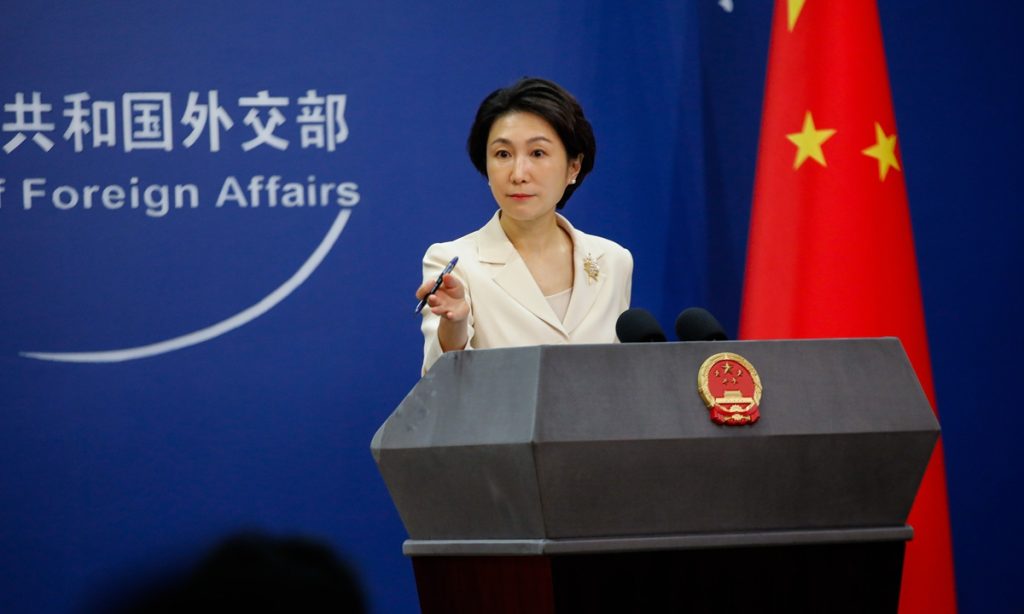
In response to the "reciprocity " cited by the US Department of State regarding media-related issues, Mao Ning, spokesperson of China's Ministry of Foreign Affairs, criticized the US's professed commitment to freedom of speech and urged Washington to implement common understandings through concrete measures to ensure Chinese journalists' lawful right to work and reside normally in the US.

At the press briefing on Wednesday, when asked to comment on a spokesperson of the US State Department claiming that the current US administration has a firm commitment to freedom of speech, and would not accept China's continued lack of reciprocity in treating US media, alleging China has long imposed restrictions on US journalists and other foreign journalists in China, Mao said the US is the one that caused the media issue. Since the two sides reached the three common understandings on this issue, China has implemented them in their entirety, and has facilitated US journalists' reporting in China in ways such as visa approvals, whereas Chinese journalists' reporting right has been severely curbed. 

Hardly any Chinese journalists are allowed to raise questions at the White House briefings. Their applications for visa or residence permits are often delayed without explanation. Multiple journalists have been forced to return to China. Chinese journalists' applications for short-term reporting rarely get approved, Mao said. 

Mao asked, " Is that what the US side means by "reciprocity"?"

Mao said that the US side keeps emphasizing freedom of speech., But when Chinese media are labeled "foreign agent" or "foreign mission" in the US, does that look like freedom of speech to the US side?

"What the US side should do is to implement the common understandings with real actions and ensure that Chinese journalists can work and stay normally in the US, which is their lawful right," Mao said. 

Observing US foreign policy requires a deep grasp of US political characteristics: Chinese scholar

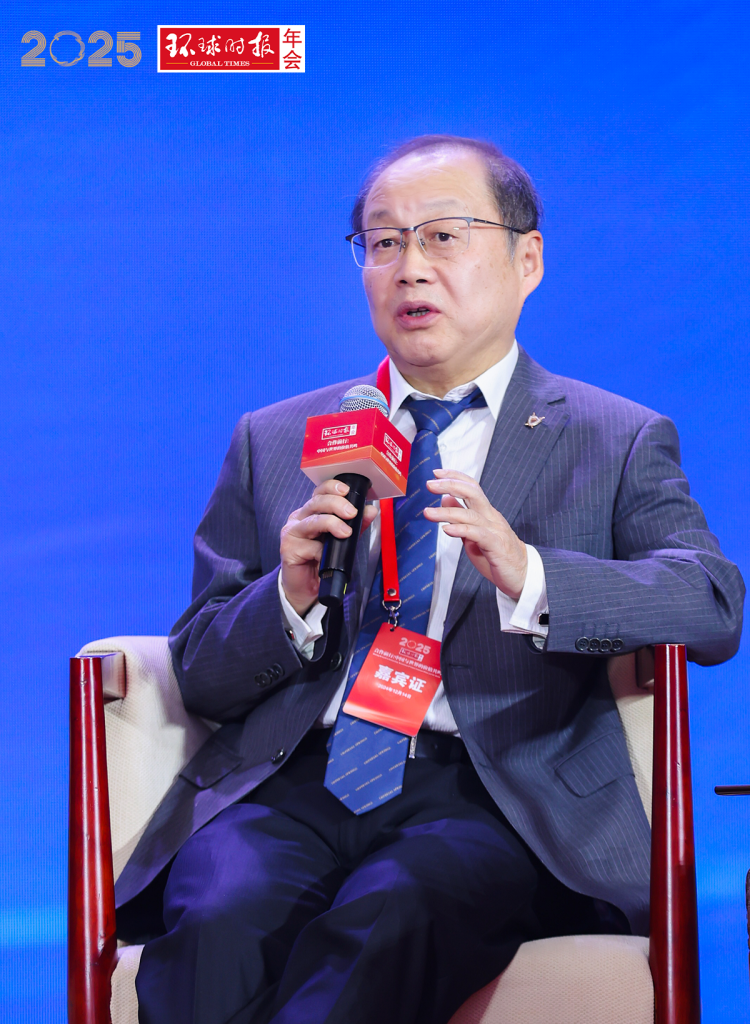
The Global Times Annual Conference 2025, themed "Moving forward in Partnership: Resonance of Values between China and the World," was held in Beijing on Saturday. During a discussion on the topic "Exploring the Path of Great Power Relations: Differences and Consensus," Fang Ning, chair professor at Sichuan University, stated that to observe US foreign policy today, it is essential to deeply understand the characteristics of US politics.

During the discussion, Cui Hongjian, professor of the Academy of Regional and Global Governance at Beijing Foreign Studies University and panel moderator, posed a question: "Despite the many challenges we face today, is it still possible for major powers to ultimately reach some kind of consensus and return to the direction of stable cooperation?" 

In response, Fang remarked, "There is a general understanding or consensus that a country's foreign policy and international relations are greatly influenced by its domestic politics. I have studied four US presidential elections over more than a decade, and this time I've gained new insights. We often talk about fundamental issues or underlying logic. So, what is the underlying logic or fundamental issue in US domestic politics? It's essentially about elections, and about votes."

Fang further explained that observing US foreign policy necessitates studying the distinct characteristics of US political system, particularly voter behavior and attitudes. He noted that modern political science, shaped by US elections, also serves electoral needs. He identified this as a fundamental issue.

23rd Special Representatives' Meeting on China-India Boundary Question to be held in Beijing: Chinese FM

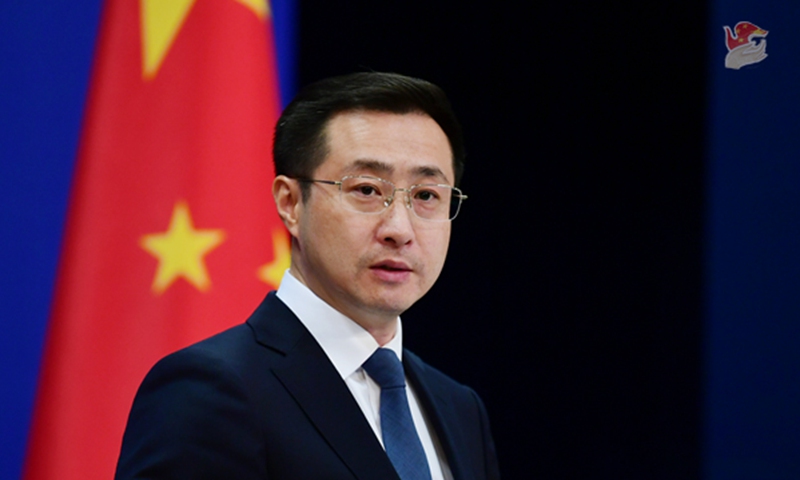
As agreed by China and India, China's Special Representative on the China-India boundary question, Member of the Political Bureau of the CPC Central Committee, and Director of the Office of the Central Commission for Foreign Affairs Wang Yi and India's Special Representative and National Security Adviser Shri Ajit Doval will hold the 23rd meeting of Special Representatives for China-India Boundary Question in Beijing on December 18, Chinese Foreign Ministry spokesperson Lin Jian announced on Monday. 

Not long ago, the Chinese and Indian leaders met in Kazan and reached important common understanding on making good use of the Special Representatives mechanism on the China-India boundary question. The two sides are in close communication on holding a meeting under the mechanism, Lin said previously during a regular Monday briefing.

Since China and India reached resolutions on issues concerning the border area, following the two leaders' meeting on the sidelines of the 16th BRICS Summit, bilateral relations have emerged from the low point, with an evident improvement momentum, Qian Feng, director of the research department at the National Strategy Institute at Tsinghua University, told the Global Times on Monday.

China and India have reached resolutions on issues concerning the border area and China will work with India for the implementation of these resolutions in October. 

Lin said at a regular press conference on October 22 that "Over a recent period of time, China and India have reached resolutions on issues concerning the border area following close communication through diplomatic and military channels. China commends the progress made and will continue working with India for the sound implementation of these resolutions."

On December 5, Director-General of the Department of Boundary and Ocean Affairs of the Foreign Ministry Hong Liang and Joint Secretary of the East Asia Division of the Ministry of External Affairs of India Gourangalal Das co-chaired the 32nd Meeting of Working Mechanism for Consultation and Coordination on China-India Border Affairs in New Delhi, according to a readout released by Chinese Ministry of Foreign Affair. 

The two sides positively evaluated the solutions reached by the two countries on border issues, and agreed to continue to fully and effectively implement the relevant solutions and take measures to further ease the border situation, according to the readout. 

These interactions all indicate that both sides are actively engaging in positive diplomatic efforts and are working to implement the consensus reached between the two leaders in Kazan, with the goal of bringing China-India relations to a path of healthy development, Qian said.

Nine people missing in fire at cold chain warehouse construction site in Shandong

Nine people are missing after heat insulation materials caught fire at a cold chain warehouse under construction in Rongcheng, East China’s Shandong Province at around 1 pm on Saturday afternoon, local emergency management department of Rongcheng announced. Rescue work is ongoing and investigation in the cause of the fire is underway.

The warehouse belongs to Qidong Haitong Cold Chain Logistics Co under Lanrun Group, said the announcement.

UNESCO adds traditional Chinese wooden arch bridges, Li textile techniques, and Qiang New Year festival as Intangible Cultural Heritage of Humanity

UNESCO added traditional Chinese wooden arch bridges, traditional Li textile techniques, and Qiang New Year festival to its Representative List of the Intangible Cultural Heritage of Humanity on Thursday, according to the Xinhua News Agency.

All the three items were previously included in 2009 in the List of Intangible Cultural Heritage in Need of Urgent Safeguarding.

The full names of the three items are "traditional design and practices for building Chinese wooden arch bridges," "traditional Li textile techniques: spinning, dyeing, weaving and embroidering," and "Qiang New Year festival."

New rocket in China’s Long March series to make maiden flight, laying foundation for reusability

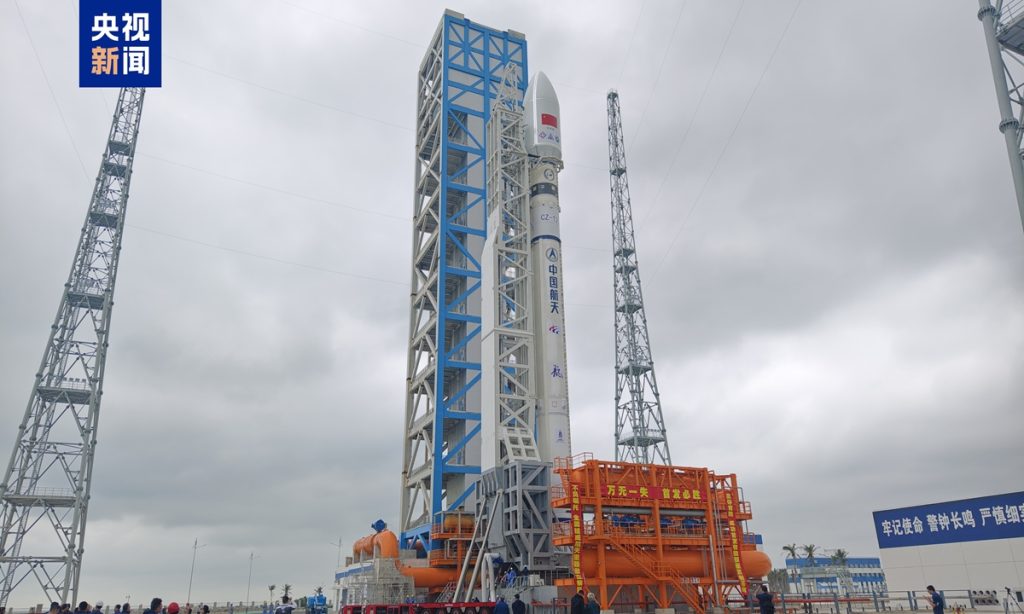
After being transported to a launch pad at the Hainan Commercial Space Launch Site on Tuesday, a new member of China's Long March carrier rocket family, the Long March-12, has been scheduled to undertake its maiden flight in the next few days.

Experts said due to its enhanced overall capacity, the new rocket, which is the country's first single-core liquid carrier rocket with a diameter of 3.8 meters, will gradually replace China's older 3.35-meter diameter series. With better reliability in attitude control, the Long March-12 is expected to become the basic model for future reusable rockets in China.

The rocket, developed by the Shanghai Academy of Spaceflight Technology, features a two-stage configuration. The first stage is powered by four liquid oxygen/kerosene engines, each with a thrust of 1,250 kilonewtons, while the second stage uses two liquid oxygen/kerosene engines with a thrust of 180 kilonewtons each, China Central Television reported.

Its payload capacity to low Earth orbit is no less than 10 tons, and its capacity to reach a 700-kilometer sun-synchronous orbit is no less than 6 tons. The rocket's fairing is standardly available in diameters of 5.2 meters and 4.2 meters, allowing for multi-size adaptation based on different missions, the report said.

Apart from the 5-meter diameter Long March-5 rocket, the "fatty" in the family, the Long March series typically features a diameter of 3.35 meters, while solid rockets are generally slimmer, with diameters usually below 3 meters. 

The Long March-12 rocket represents a significant advancement in the country's space launch capabilities, as the increased diameter addresses the limitations of the previous 3.35-meter rockets, allowing for more powerful engines, enhanced payload capacity, and better expandability of rocket thrust. Therefore, the Long March-12 is expected to significantly improve overall launch capability compared to previous generations, gradually replacing the older 3.35-meter models, Chinese space analyst Song Zhongping told the Global Times on Tuesday.

According to CCTV, the pioneering shape of the Long March-12 is based on the improved development of China's new generation of main liquid oxygen/kerosene engines, the YF-100 series, and is the result of repeated verification, research, and testing. 

This notable feature allows for both railway transportation to various launch sites and the optimization of compatibility between the rocket's diameter and the number of engines, facilitating capability expansion and thus laying the groundwork for future reusable rockets, experts said.

Song pointed to an important technical parameter for launch vehicles, the length-to-diameter ratio, which affects the rocket's stability during recovery. 

"Theoretically, a more optimal length-to-diameter ratio enhances the stability of a reusable rocket. The previous 3.35-meter rocket was relatively slender and long, making it more challenging to control its attitude. By increasing the diameter, the length-to-diameter ratio can be reduced, making it easier to control the rocket's stability and facilitating recovery," he said. 

The expert anticipates that the Long March-12 rocket will become the basic model for future reusable rockets in China, while allowing for the development of various configurations based on it. This standardization will be crucial for the future of rocket recovery and reuse, Song noted.

Previous media reports said the Hainan Commercial Space Launch Site will be equipped with two liquid rocket launch pads. The first launch pad will be dedicated to the Long March-8 carrier rocket, while the other launch pad will provide launch services for the Long March-12 vehicle.

China sets to build next-generation BeiDou system

China is planning to develop the next-generation BeiDou system that is technologically more advanced, functionally more powerful and offers higher quality services.

An experimental satellite of the system is scheduled for launch around 2027, while network deployment will begin by around 2029 and be completed by 2035.