Romance and suspense are carrying Chinese AI micro-dramas abroad. What comes next?
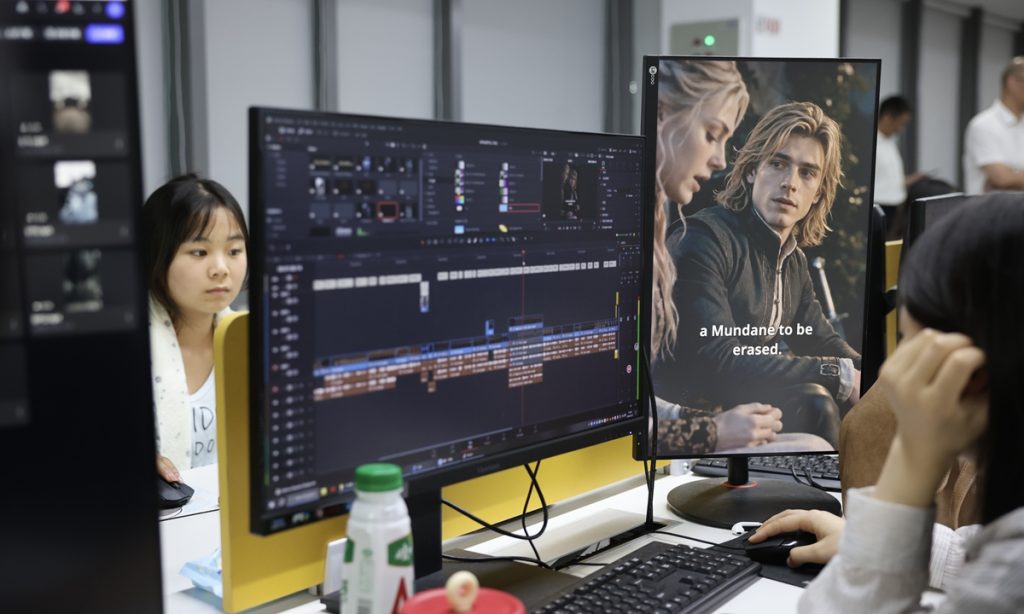
In the evening bustle of Shanghai, a middle-aged woman sits in a metro train car, head down, scrolling through short videos on her phone. She flicks past dozens of clips, yet can hardly find a single micro-drama shot with real actors and cameras.
"At a glance, it's all AI-generated faces and scenes. If you don't look closely, you can barely tell what's real and what isn't," she told the Global Times.
Deep into the night in New York, in a college dorm room, a student comes across a Chinese-made suspense micro-drama on TikTok. Its eerily realistic post-apocalyptic landscapes and subtle character expressions make him think at first that he is watching a trailer for a new Hollywood release.
"Wait… this is actually AI-generated?" he writes in the comments, shocked at how real it looks.
These two seemingly distant scenes are connected by the same thread: Chinese AI-generated micro-dramas. In just the past year or two, they have swept across users' phone screens in China, and, carried by the currents of the internet, are now streaming into global markets.
According to DataEye, a leading industry platform, the global market for AI-produced dramas and animated dramas overseas was expected to be worth about $100 million in 2025, before surging to $650 million in 2026 - a staggering year-on-year increase of 550 percent.
Drawn by this unprecedented boom, what is the current state of Chinese AI micro-dramas going abroad? And what does the industry's broader development look like inside China? The Global Times recently spoke with some Chinese AI micro-drama creators, overseas distribution service providers and industry observers who shared their on-the-ground observations and insights into this fast-growing sector.
Go overseas
An AI-generated micro-drama, The Persian Revenge, reportedly cost just 3,000 yuan ($443) to make, yet within 72 hours of going live on international platform YourChannel, it had generated more than $500,000 in paid revenue, the Hubei Daily reported on May 20.
That more than 1,000-fold return on production costs made the series one of the standout moments in the overseas expansion of China's AI micro-drama industry this year. "Three thousand yuan is only enough for a traditional crew to rent a location in some overseas cities for half a day," read the report.
The use of AI has dramatically lowered production costs across film and television. And, according to Ni Kaomeng, a veteran observer of the AI micro-drama industry and initiator of the China AIGC (AI generated content) Industrial Alliance, the first wave of China's AI micro-dramas going global was driven largely by one thing: saving money.
Before AI technology matured, China's micro-dramas entering overseas markets followed a capital-intensive model, Ni said. In previous years, he recalled, localization often meant filming abroad, or building sets in China and hiring foreign actors. The process was expensive and time-consuming.
AI has changed that cost equation almost overnight. According to the Hubei Daily, in the past, merely translating a micro-drama for overseas release could cost tens of thousands of yuan. Now, AI-powered translation and dubbing can reduce the cost by more than 90 percent, while pushing accuracy above 95 percent.
"As early as the end of 2024, we learned that some teams had already begun using AI to make micro-dramas for overseas audiences," Ni told the Global Times. "There's no need to hire foreign actors, no need to build sets, and translation and dubbing can be generated with a single click. Costs have fallen sharply." And later, this model quickly evolved from simple translation and face-swapping, into something more sophisticated: the creation of dedicated "actor asset libraries" and "scene asset libraries," enabling the industrial-scale production of AI micro-dramas.
As the overseas short drama market continued its explosive growth, the Securities Daily reported on June 1 that orders for China's AI micro-dramas abroad had recently entered a boom phase, "with full-year growth expected to reach as much as 50-fold." Some of the dramas have become highly popular overseas, drawing not only strong viewership but also viral traction from clipped excerpts on social media. Revenge of XXL Wife, for example, has surpassed 200 million cumulative views across related clips.
The surge in output, however, has also brought uneven quality. Ni observed that overseas AI short dramas now show clear stratification.
"The highest-quality productions are directly benchmarked against the standards of US television, and some have even been sold to Netflix," said Ni. Such premium overseas productions are typically polished, narratively complex and far more lucrative than their ordinary Chinese domestic peers, he said.
China's AI micro-dramas going overseas are not a simple matter of "one-size-fits-all" content export. Different countries and regions have different viewing preferences.
According to a white paper on the development of China's micro-drama industry, romance still accounts for more than 70 percent of global micro-drama viewership, with classic tropes such as "dominant CEO romance" and "marriage of convenience" proving especially popular among women aged 45 to 64 in Europe and the US. In Latin America and Germany, audiences tend to favor crime and revenge stories, while younger viewers in Southeast Asia are drawn to fantasy narratives. These preferences largely apply to AI short dramas as well, the Xinhua News Agency reported.
Booms under pressure
As the number of AI micro-dramas going overseas has surged, the "escort fleet" supporting them has also begun to take shape.
"AI-created content is not short of good stories; what it lacks is a complete chain that runs from rights confirmation to going global, from a work to an asset," said a director at Vobile Group, a leading provider of digital copyright protection services. "We're building that path for creators."
Earlier this year, a drama titled Ma: The Word We're Born With went viral and also won several awards at home and abroad. But success quickly brought new challenges. AI-generated content is easier to copy, clip and misuse. However, when the team tried to monetize the work on overseas platforms, they found they were still unable to clear even the basic entry threshold - YouTube channels must meet certain subscriber and watch-time requirements before they can apply for its Partner Program, and only then can they begin earning revenue, according to the director.
"First, we used digital fingerprinting and watermarking technologies to make the drama identifiable, traceable and protected; second, we opened the route to overseas distribution, enabling the drama to be successfully published on foreign platforms and truly begin generating creative income," the director said.
As an industry insider, she has observed a strong push for Chinese AI micro-dramas to go global over the past year or two. "The market now includes both high-quality works that have won praise on mainstream overseas platforms, and fast-paced content tailored to broader audience preferences," she told the Global Times. "Overall, growth has been rapid."
Some service providers also offer copyright protection for AI micro-dramas going overseas, including registering creators' works in a database and embedding digital watermarks. "If infringement occurs, they can help hold the infringers accountable globally," Ni told the Global Times.
At the policy level, for instance, Shanghai released a series of support policies for AI micro-dramas in May, emphasizing the need to strengthen copyright protection, according to the Shanghai Municipal Administration of Culture and Tourism website.
Still, with a flood of players rushing in, the AI micro-drama overseas market is becoming increasingly crowded.
"Intense internal competition has already emerged," said Song Donghuan, a veteran AI short drama creator and founder of StoryStorm, a community for tens of thousands of Chinese AI content creators. Song said that prices for AI micro-dramas purchased by overseas buyers have been falling.
"Last year, some overseas platforms were paying four to five thousand yuan per minute. This year, because of the rapid iteration of domestic AI models and therefore a sharp drop in production barriers, some have driven it down to as low as 500 yuan per minute," Song told the Global Times.
The price barely covers computing costs, and that may be an unhealthy, discouraging trend, he noted. "But creators are still taking the work, because there are so many people in the field. If you don't do it, someone else will."
Culture over code
The sprint into overseas markets is just one reflection of the broader boom in China's AI micro-drama industry.
Data showed that about 128,000 micro-short dramas were launched in the first quarter of 2026, of which roughly 122,000 were AI-generated, accounting for more than 95 percent, the Guangming Daily reported on May 1.
The sector's surge has also triggered an explosive rise in the number of practitioners. Song estimates that around 2 million people in China are now involved in AI micro-drama-related work, including many who have shifted over from the traditional drama industry. "Those who got in earlier did so, in many cases, out of passion and foresight."
Bona Film Group was among the first film companies to make an early bet on AI products. In early 2024, when much of the industry was still using AI only to create a few seconds of brief material, the company set up an AIGMS (AI Generated Movie/Series) production center and began producing AI-driven content in earnest.
"The theme we chose was probably one of the toughest nuts to crack - China's Sanxingdui Ruins site," Quji Xiaojiang, head of Bona Film Group's AIGMS production center, told the Global Times. Back then, the ancient Chinese civilization site, steeped in mystery, was extremely difficult for AI to generate convincingly. It took the team five months of trial and error to produce the first season: a 12-episode AI animated micro-drama titled Sanxingdui - Future Revelation.
"Because of the then technical limitations, we had AI generate the content first, and then we wrote the story based on what it produced," she recalled. A central character in the show was a "humanity's last warrior," a concept that actually came from an image of a doomsday scene generated by AI almost by accident. "That image gave us a lot of inspiration," she said.
As one of the early standout productions in China's AI micro-drama space, Sanxingdui - Future Revelation later proved to be both critically acclaimed and commercially successful, added Quji. She mentioned that the first season achieved strong viewership and earned multiple international industry accolades, including the Official Selection of the American Filmatic Arts Awards 2025.
The entry of professional film companies has been seen by some observers as a victory for the "regular army." But Ni believes the market as a whole remains sharply polarized.
"High-quality productions may account for less than 10 percent, and there is still a huge amount of shoddy AI content on the market," Ni told the Global Times. He nonetheless believes that Chinese domestic AI micro-dramas have already moved beyond their wild-growth phase. "The industry will inevitably become more refined and more standardized."
So what does a "high-quality" AI micro-drama look like? Near the end of the interview, Ni shared with the Global Times reporter a few China-made AI micro-dramas being released overseas. When one of them was opened, a suspense thriller with a cool, desaturated palette, carefully composed shots, nuanced facial expressions and perfect musical scoring immediately drew the viewer into its fictional world. Without the small "AI-generated" label at the beginning, few might be able to tell it apart from a Netflix original.
"Today, technology is no longer the biggest barrier. Storytelling, cultural expression and compliant operations are the real core competencies of AI micro-dramas," Ni said. He predicted that Chinese AI short dramas will continue to deepen their presence in global markets, while also incorporating interactive elements, branching narratives and other new formats. "It is time to bring Chinese original stories to a wider world through AI-powered digital imagery."