Individuals punished for cyberbullying village official after spreading rumors about her wearing 'gold earrings' during flood relief work

Several individuals have been administratively punished for cyberbullying a village Party secretary in Central China's Hunan Province after spreading rumors about her wearing "gold earrings" while engaged in flood relief work, the Xinhua News Agency reported on Tuesday, citing China's Ministry of Public Security.

According to the report, Shimen County in Hunan Province was recently hit by heavy rainfall. A village cadre remained on the front line of flood control and disaster relief for several consecutive days, going door to door to alert residents, organizing evacuations, arranging temporary shelter, and delivering supplies. Her dedication moved many netizens.

However, while society was rallying to support disaster-relief efforts, a small number of netizens made groundless accusations against her because of the accessories she wore during an interview. They speculated that "the earrings weigh two liang (about 100 grams)," and posted belittling and mocking comments such as "ordinary rural women can't afford gold earrings" and "it would be more touching if she donated the earrings." Their actions interfered with flood relief efforts and created a highly negative impact, according to the Xinhua report.

Public security and cyber security authorities moved swiftly to investigate the case and handled 15 incidents of cyberbullying in accordance with the law. A 44-year-old man surnamed Qin, and a 45-year-old man surnamed Wei, among others, were given administrative penalties in accordance with the law, per Xinhua.

The cyber security department of the public security authorities said it will continue its "Clean Internet" campaign, focusing on tackling prominent online problems such as cyberbullying, online trolls, and online rumors, while cracking down on related illegal and criminal activities to safeguard the lawful rights and interests of the public and maintain order in cyberspace.
Chinese FM spokesperson says US caused media issue, calls on Washington to ensure lawful rights of Chinese journalists in the country

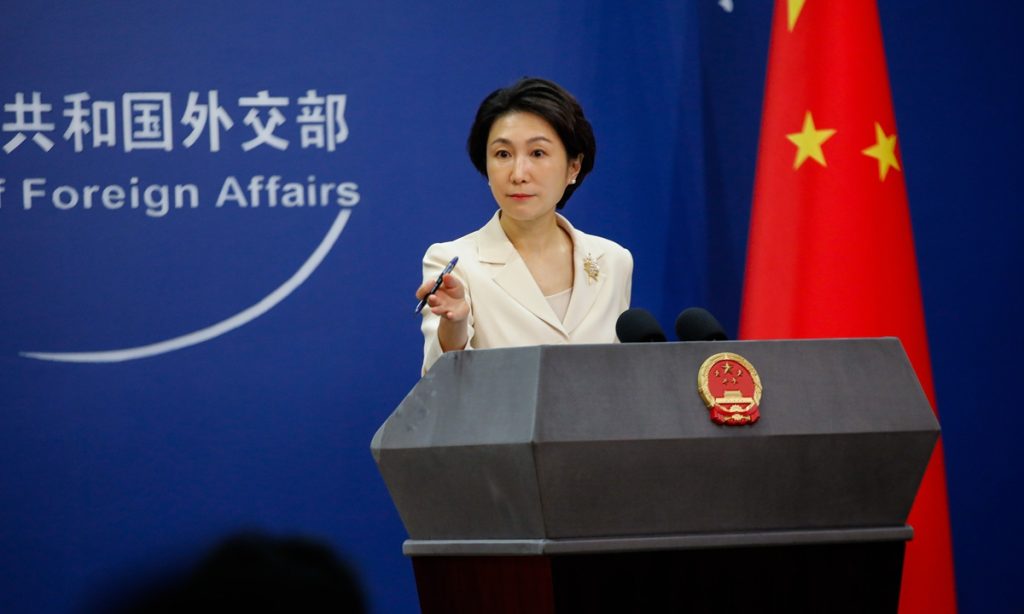
In response to the "reciprocity " cited by the US Department of State regarding media-related issues, Mao Ning, spokesperson of China's Ministry of Foreign Affairs, criticized the US's professed commitment to freedom of speech and urged Washington to implement common understandings through concrete measures to ensure Chinese journalists' lawful right to work and reside normally in the US.

At the press briefing on Wednesday, when asked to comment on a spokesperson of the US State Department claiming that the current US administration has a firm commitment to freedom of speech, and would not accept China's continued lack of reciprocity in treating US media, alleging China has long imposed restrictions on US journalists and other foreign journalists in China, Mao said the US is the one that caused the media issue. Since the two sides reached the three common understandings on this issue, China has implemented them in their entirety, and has facilitated US journalists' reporting in China in ways such as visa approvals, whereas Chinese journalists' reporting right has been severely curbed. 

Hardly any Chinese journalists are allowed to raise questions at the White House briefings. Their applications for visa or residence permits are often delayed without explanation. Multiple journalists have been forced to return to China. Chinese journalists' applications for short-term reporting rarely get approved, Mao said. 

Mao asked, " Is that what the US side means by "reciprocity"?"

Mao said that the US side keeps emphasizing freedom of speech., But when Chinese media are labeled "foreign agent" or "foreign mission" in the US, does that look like freedom of speech to the US side?

"What the US side should do is to implement the common understandings with real actions and ensure that Chinese journalists can work and stay normally in the US, which is their lawful right," Mao said. 

AI-enabled robotic mastiff unveiled at military expo, boasting auxiliary surveillance and strike functions for combat personnel: expert

A cutting-edge artificially intelligent (AI) military device, named "robotic mastiff," made its debut at this year's China (Beijing) Military Intelligent Technology Expo. A Chinese military affairs expert said that such robotic mastiff serves as an extra pair of "eyes" for frontline combat personnel, allowing them to detect threats and conditions in otherwise inaccessible areas maximizing battlefield effectiveness.

A major strength of the robotic mastiff lies in its open base, which can be fitted with a wide range of equipment. Depending on its size, the robotic mastiff can be divided into two types. The smaller one, named the "Ying'ao," can be equipped with machine guns, reconnaissance devices, and self-detonation gear, according to CCTV News.

Built for stealth surveillance, behind-enemy-line infiltration and silent mobility, it conducts detection and reconnaissance across visible light, infrared and laser spectrums, and performs well in complex terrains such as mountainous areas and wilderness.

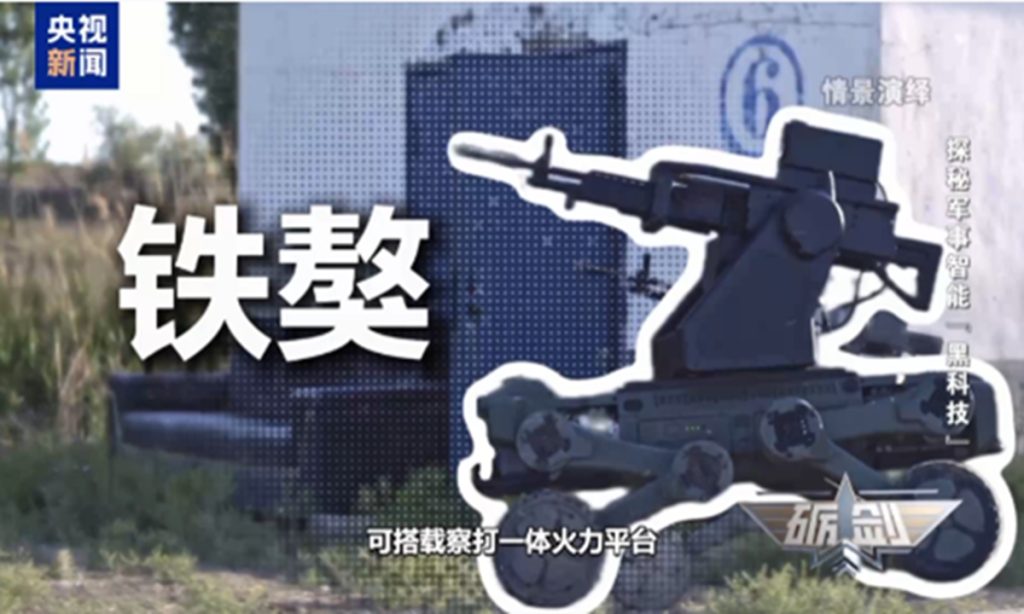
The larger one, called the "Tie'ao," can carry an integrated fire platform for surveillance and strike, transport containers, and rocket launchers. It supports wide-range firing up to 240 degrees and is capable of autonomous pursuit, undertaking missions such as forward assault and fire support, the report said. 

Chinese military affairs expert Song Zhongping told the Global Times on Friday that the robotic mastiff is capable of performing high-risk, arduous combat missions, demonstrating advantages in counter-terrorism operations and street battles in traditional warfare. Powered by AI, it can autonomously detect and engage targets, which is its core operational strength, he added.

Operating in coordination with combat personnel, it also enables precision strikes against hostile targets, extending operational reach and enhancing battlefield precision, Song said, adding that the equipment is specifically deployed to neutralize hardened fortified positions and point targets that are difficult to defeat through conventional means.

In addition to size-based classification, the robotic mastiff also comes in wheeled and quadrupedal forms. The wheeled-legged version is designed for speed, excelling at pursuit missions on flat, open terrain, while the quadruped one offers superior accessibility, enabling it to navigate buildings and obstacle-strewn terrain.

Such robotic mastiff will be integrated into future system‑of‑system combat operations, forming a closed operational loop encompassing group control, coordinated engagement, task allocation, autonomous situational awareness, autonomous task distribution, and mission execution, CCTV News, citing exhibitors, reported.

In counter-terrorism and street combat scenarios, battlefields feature extensive visual blind spots, with complex terrains that are inaccessible and risky for infantry personnel, Song said, adding that therefore AI-powered robotic mastiff effectively serve as "eyes" for ground troops, endowing them with auxiliary surveillance and strike capabilities to detect visual and acoustic cues.

CCTV News also reported that all types of unmanned equipment are expected to achieve collaborative operations within a unified command system.

By leveraging artificial intelligence to operate alongside the robotic mastiff, our forces can achieve maximum battlefield effect while minimizing casualties, Song said.

China, Egypt sign deals to boost lunar exploration, spacecraft launching

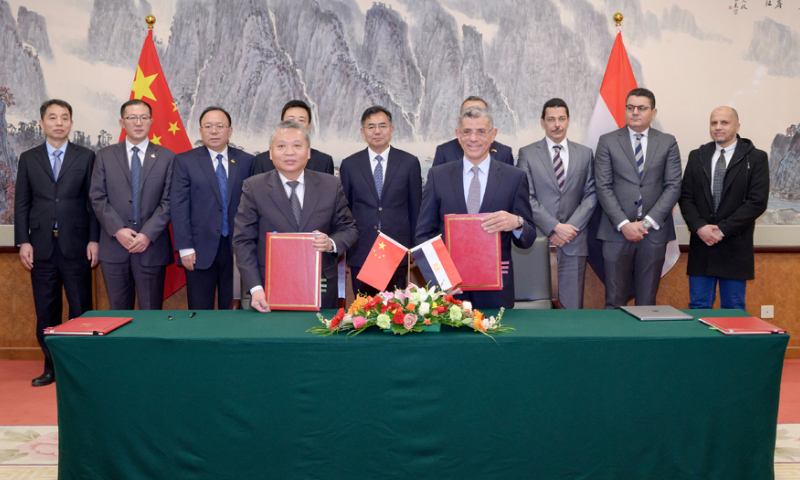
China and Egypt have signed cooperation documents in space exploration in Beijing on Wednesday to boost deep space exploration, spacecraft development and construction of space infrastructure, which is of great significance to foster a comprehensive strategic partnership between the two countries.

Zhang Kejian, administrator of the China National Space Administration (CNSA) and Sherif Sedky, Chief Operating Officer of the Egyptian Space Agency (EGSA), signed a memorandum of understanding between the governments of the two countries on space cooperation and peaceful use of outer space and a cooperation agreement between the CNSA and the EGSA on the International Lunar Research Station (ILRS).

According to the cooperation documents, both sides will encourage joint researches and development cooperation in a variety of areas including lunar and deep space exploration, development and launch of spacecraft, construction of space infrastructure, satellite data reception and application, the BRICS Remote Sensing Satellite Constellation, space science and astronomical observation.

They will also collaborate on the joint demonstration and research of the ILRS, space missions, space systems and subsystems, space equipment, ground segments and applications, education and training and capacity building.

China and Egypt have achieved fruitful results in space cooperation. The China-assisted Egyptian Satellite Assembly, Integration and Test Center completed the acceptance checks in June this year. The China-funded MisrSat-2 satellite completed its assembly and testing at the center and was launched on Monday.

The satellite MisrSat-2, launched by a Long March-2C carrier rocket from the Jiuquan Satellite Launch Center in Northwest China's Gansu Province, will be used in Egypt's land and resource utilization, water conservancy, agriculture, and other fields. It is a landmark project of deep cooperation between China and Egypt in the field of aerospace high-tech, and is of milestone significance in aerospace cooperation between the two countries, according to the CNSA.

The signing of these space agreements between China and Egypt will guide future collaboration and play a significant role in advancing space technology and fostering comprehensive strategic partnerships between the two countries, said CNSA in a press release on Wednesday.

Italy: The Week of Italian Cuisine in the World kicks off in Beijing, Tianjin and Qingdao

The Week of Italian Cuisine in the World kicked off on Monday, with the aim to promote exquisite Italian cooking, the Mediterranean diet, Italian agri-food products and wine. In the 2023 edition, as in past years, the week will be further enhanced by activities organized by the Italian Embassy in China together with the Italian business community operating in China. 

Several Italian restaurants in Beijing, Tianjin, and Qingdao have been preparing special menus and typical dishes for Chinese friends and expatriates residing in China to enjoy throughout the Italian cuisine week that is set to run until November 19. Beijing's ABBOCCA restaurant, for instance, has provided a special selection for homemade fresh cheeses called "TRILOGY," which includes mozzarella, stracciatella, and ricotta, and has been dubbed a tasty journey through salty and sweet to stimulate all senses complete with fresh basil leaves, cherry tomatoes.

How one enslaving wasp eats through another

Parasites can drive their hosts to do weird, dumb things. But in certain oak trees, the parasites themselves get played.

“Creepy and awesome,” says Kelly Weinersmith of Rice University in Houston, who has helped reveal a Russian doll of nested parasitisms.

The saga begins when two majestic live oak species in the southeastern United States send out new shoots, and female crypt gall wasps (Bassettia pallida) arrive to lay eggs. A wasp mom uses the delivery ­end of her reproductive tract to drill through tree bark, injecting each of her eggs into a separate spot in the oak.
Wasp biochemistry induces the tree to form a botanical womb with an edible lining largely free of oak defense chemicals. The tree is hijacked into nurturing each larva, and wasp life is good — until the unlucky ones get noticed by a second exploiter.

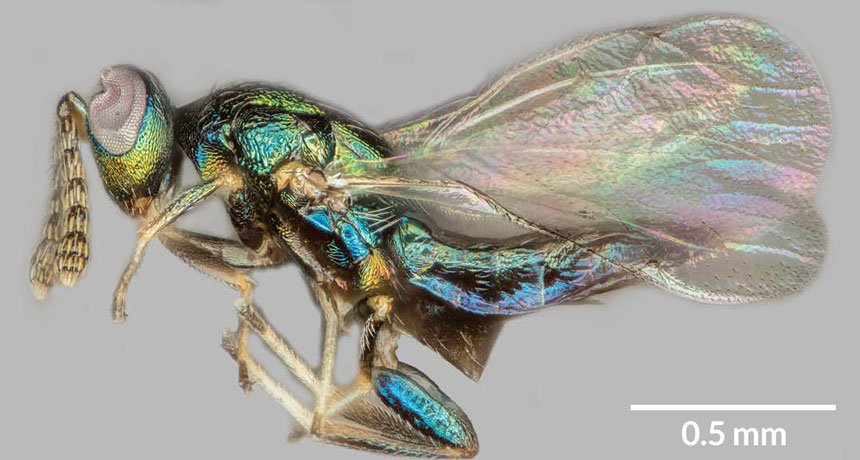
Another wasp species, a newly discovered Euderus, arrives, barely visible to the naked eye but “amazingly iridescent,” Weinersmith says. Her colleague at Rice, Scott Egan, named these jewel blue and green specks after Set, an Egyptian god of evil and chaos.
E. set wasps enslave the B. pallida as laborers and living baby food. E. set females sense their prey inside the gall and inject eggs that hatch and feed on the original occupant. When the invaders mature, they are typically too frail to dig themselves out of the tree.But that’s not a problem, Weinersmith, Egan and colleagues report in the Jan. 25 Proceedings of the Royal Society B. That’s because, despite having a gnawing parasite inside, B. pallida wasps dig a tunnel to freedom.

Almost. When infested with E. set, the tunnelers don’t manage a large enough hole for their own escape. They die with their heads plugging the tunnel exit, perfect for the E. set attackers, who chew an escape hole through the stuck noggins.

Weinersmith and Egan may be the first to describe E. set’s manipulation, but what could be a much earlier example was collected by Alfred Kinsey — yes, that Kinsey. Before shocking mid-20th century America with explicit chronicles of human sexual behavior, he specialized in gall wasps.

Kinsey named more than 130 new species in just three years, collecting at least 5.5 million specimens, now at New York’s American Museum of Natural History. One of his Bassettia has its head stuck in a too-small exit hole in a stem, suggesting a chaos-and-death wasp lurks inside.

A new map exhibit documents evolving views of Earth’s interior

Much of what happens on the Earth’s surface is connected to activity far below. “Beneath Our Feet,” a temporary exhibit at the Norman B. Leventhal Map Center in the Boston Public Library, explores the ways people have envisioned, explored and exploited what lies underground.

“We’re trying to visualize those places that humans don’t naturally go to,” says associate curator Stephanie Cyr. “Everybody gets to see what’s in the sky, but not everyone gets to see what’s underneath.”
“Beneath Our Feet” displays 70 maps, drawings and archaeological artifacts in a bright, narrow exhibit space. (In total, the library holds a collection of 200,000 maps and 5,000 atlases.) Many objects have two sets of labels: one for adults and one for kids, who are guided by a cartoon rat mascot called Digger Burrows.

The layout puts the planet’s long history front and center. Visitors enter by walking over a U.S. Geological Survey map of North America that is color-coded to show how topography has changed over geologic time.
Beyond that, the exhibit is split into two main themes, Cyr says: the natural world, and how people have put their fingerprints on it. Historical and modern maps hang side by side, illustrating how ways of thinking about the Earth developed as the tools for exploring it improved.

For instance, a 1665 illustration drawn by Jesuit scholar Athanasius Kircher depicts Earth’s water systems as an underground network that churned with guidance from a large ball of fire in the planet’s center, Cyr says. “He wasn’t that far off.” Under Kircher’s drawing is an early sonar map of the seafloor in the Pacific Ocean, made by geologists Marie Tharp and Bruce Heezen in 1969 (SN: 10/6/12, p. 30). Their maps revealed the Mid-Atlantic Ridge. Finding that rift helped to prove the existence of plate tectonics and that Earth’s surface is shaped by the motion of vast subsurface forces.

On another wall, a 1794 topological-relief drawing of Mount Vesuvius — which erupted and destroyed the Roman city of Pompeii in A.D. 79 — is embellished by a cartouche of Greek mythological characters, including one representing death. The drawing hangs above a NASA satellite image of the same region, showing how the cities around Mount Vesuvius have grown since the eruption that buried Pompeii, and how volcano monitoring has improved.

The tone turns serious in the latter half of the exhibit. Maps of coal deposits in 1880s Pennsylvania sit near modern schematics explaining how fracking works (SN: 9/8/12, p. 20). Reproductions of maps of the Dakotas from 1886 may remind visitors of ongoing controversies with the Dakota Access Pipeline, proposed to run near the Standing Rock Sioux Reservation, and maps from the U.S. Environmental Protection Agency mark sites in Flint, Mich., with lead-tainted water.

Maps in the exhibit are presented dispassionately and without overt political commentary. Cyr hopes the zoomed-out perspectives that maps provide will allow people to approach controversial topics with cool heads.

“The library is a safe place to have civil discourse,” she says. “It’s also a place where you have access to factual materials and factual resources.”

A key virus fighter is implicated in pregnancy woes

An immune system mainstay in the fight against viruses may harm rather than help a pregnancy. In Zika-infected mice, this betrayal appears to contribute to fetal abnormalities linked to the virus, researchers report online January 5 in Science Immunology. And it could explain pregnancy complications that arise from infections with other pathogens and from autoimmune disorders.

In pregnant mice infected with Zika virus, those fetuses with a docking station, or receptor, for immune system proteins called type I interferons either died or grew more poorly compared with fetuses lacking the receptor. “The type I interferon system is one of the key mechanisms for stopping viral infections,” says Helen Lazear, a virologist at the University of North Carolina at Chapel Hill, who coauthored an editorial accompanying the study. “That same [immune] process is actually causing fetal damage, and that’s unexpected.”
Cells infected by viruses begin the fight against the intruder by producing type I interferons. These proteins latch onto their receptor on the surfaces of neighboring cells and kick-start the production of hundreds of other antiviral proteins.

Akiko Iwasaki, a Howard Hughes Medical Institute investigator and immunologist at Yale School of Medicine, and her colleagues were interested in studying what happens to fetuses when moms are sexually infected with Zika virus. The researchers mated female mice unable to make the receptor for type I interferons to males with one copy of the gene needed to make the receptor. This meant that moms would carry some pups with the receptor and some without in the same pregnancy.

Pregnant mice were infected vaginally with Zika at one of two times — one corresponding to mid‒first trimester in humans, the other to late first trimester. Of the fetuses exposed to infection earlier, those that had the interferon receptor died, while those without the receptor continued to develop. For fetuses exposed to infection a bit later in the pregnancy, those with the receptor were much smaller than their receptor-lacking counterparts.

Story continues below graphic
The fetuses without the receptor still grew poorly due to the Zika infection, which is expected given their inability to fight the infection. What was striking, Iwasaki says, is that the fetuses able to fight the infection were more damaged, and were the only fetuses that died.

It’s unclear how this antiviral immune response causes fetal damage. But the placentas—which, like their fetuses, had the receptor — didn’t appear to provide those fetuses with enough oxygen, Iwasaki says.

The researchers also infected pregnant mice that had the receptor for type I interferons with a viral mimic — a bit of genetic material that goads the body to begin its antiviral immune response — to see if the damage happened only during a Zika infection. These fetuses also died early in the pregnancy, an indication that perhaps the immune system could cause fetal damage during other viral infections, Iwasaki notes.

Iwasaki and colleagues next added type I interferon to samples of human placental tissue in dishes. After 16 to 20 hours, the placental tissues developed structures that resembled syncytial knots. These knots are widespread in the placentas of pregnancies with such complications as preeclampsia and restricted fetal growth.

Figuring out which of the hundreds of antiviral proteins made when type I interferon ignites the immune system can trigger placental and fetal damage is the next step, says Iwasaki. That could provide more understanding of miscarriage generally; other infections that cause congenital diseases, like toxoplasmosis and rubella; and autoimmune disorders that feature excessive type I interferon production, such as lupus, she says.

The great Pacific garbage patch may be 16 times as massive as we thought

We’re going to need a bigger trash can.

A pooling of plastic waste floating in the ocean between California and Hawaii contains at least 79,000 tons of material spread over 1.6 million square kilometers, researchers report March 22 in Scientific Reports. That’s the equivalent to the mass of more than 6,500 school buses. Known as the great Pacific garbage patch, the hoard is four to 16 times as heavy as past estimates.

About 1.8 trillion plastic pieces make up the garbage patch, the scientists estimate. Particles smaller than half a centimeter, called microplastics, account for 94 percent of the pieces, but only 8 percent of the overall mass. In contrast, large (5 to 50 centimeters) and extra-large (bigger than 50 centimeters) pieces made up 25 percent and 53 percent of the estimated patch mass.
Much of the plastic in the patch comes from humans’ ocean activities, such as fishing and shipping, the researchers found. Almost half of the total mass, for example, is from discarded fishing nets. A lot of that litter contains especially durable plastics, such as polyethylene and polypropylene, which are designed to survive in marine environments.
To get the new size and mass estimates, Laurent Lebreton of the Ocean Cleanup, a nonprofit foundation in Delft, the Netherlands, and his colleagues trawled samples from the ocean surface, took aerial images and simulated particle pathways based on plastic sources and ocean circulation.
Aerial images provided more accurate tallies and measurements of the larger plastic pieces, the researchers write. That could account for the increase in mass over past estimates, which relied on trawling data and images taken from boats, in addition to computer simulations. Another possible explanation: The patch grew — perhaps driven by an influx of debris from the 2011 tsunami that hit Japan and washed trash out to sea (SN: 10/28/17, p. 32).

Hayabusa2 has blasted the surface of asteroid Ryugu to make a crater

Hayabusa2 has blasted the asteroid Ryugu with a projectile, probably adding a crater to the small world’s surface and stirring up dust that scientists hope to snag.

The projectile, a two-kilogram copper cylinder, separated from the Hayabusa2 spacecraft at 9:56 p.m. EDT on April 4, JAXA, Japan’s space agency, reports.

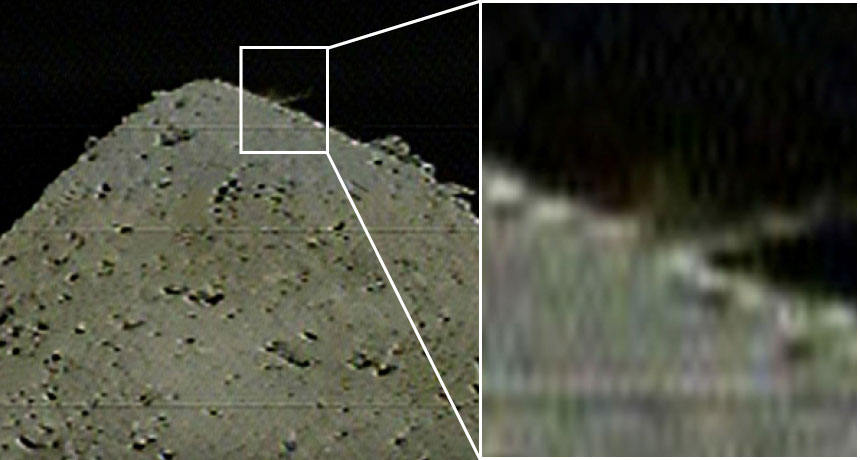
Hayabusa2 flew to the other side of the asteroid to hide from debris that would have been ejected when the projectile hit (SN: 1/19/19, p. 20). Scientists won’t know for sure whether the object successfully made a crater, and, if so, how big it is, until the craft circles back. But by 10:36 p.m. EDT, Hayabusa2’s cameras had captured a blurry shot of a dust plume spurting up from Ryugu, so the team thinks the attempt worked.
“This is the world’s first collision experiment with an asteroid!” JAXA tweeted.

Hayabusa2 plans to briefly touch down inside the crater to pick up a pinch of asteroid dust. The spacecraft has already grabbed one sample of Ryugu’s surface (SN Online: 2/22/19). But dust exposed by the impact will give researchers a look at the asteroid’s subsurface, which has not been exposed to sunlight or other types of space radiation for up to billions of years.

If all goes as planned, Hayabusa2 will return to Earth with both samples in late 2020. A third planned sample pickup has been scrapped because Ryugu’s boulder-strewn surface is so hazardous for the spacecraft.
Comparing the two samples will reveal details of how being exposed to space changes the appearance and composition of rocky asteroids, and will help scientists figure out how Ryugu formed (SN Online: 3/20/19). Scientists hope that the asteroid contains water and organic material that might help explain how life got started in the solar system.