US, Iran agree on two-week ceasefire right before deadline; China welcomes arrangement, endorsing enduring peace, security in the region: FM
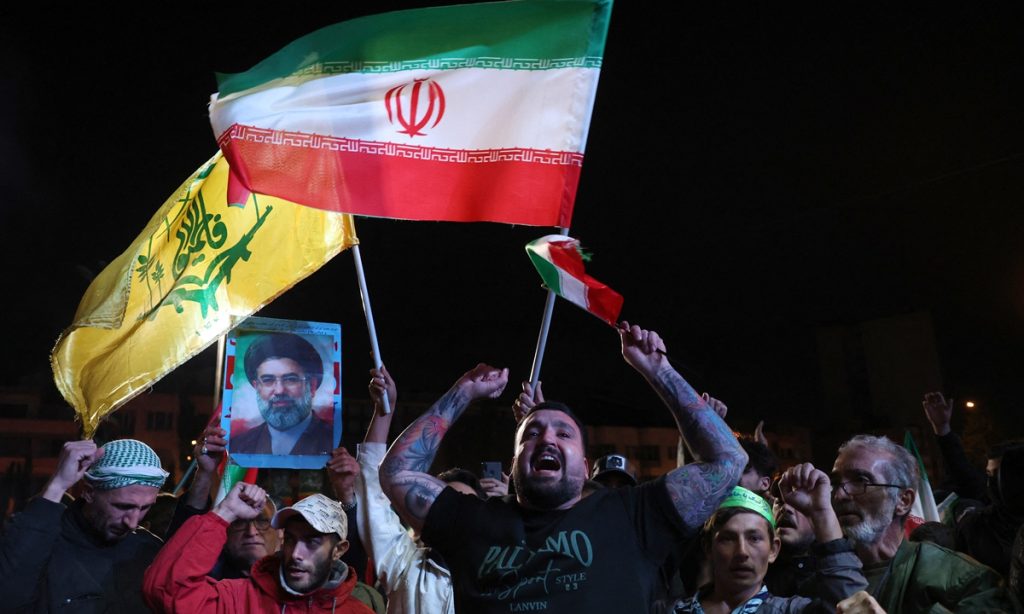
While several TV stations, including Israel's Channel 13 and Fox News, were counting down to the 8 pm (00:00 GMT) deadline set by US President Donald Trump for Iran to open the Strait of Hormuz, or "a whole civilization will die," the US leader surprisingly announced a two-week ceasefire with Iran on Tuesday, about one and half hours before the deadline.
Iran later confirmed the two-week ceasefire deal brokered by Pakistan, saying it does not mean an end to the war as Tehran released its own 10-point peace plan.
In a stunning turn of events closely watched by the world, the US-Israeli military operation against Iran that had dragged on for over a month has dramatically reversed, ushering in a significant de-escalation of tensions.
Chinese Foreign Ministry spokesperson Mao Ning said on Wednesday that China welcomes the announcement of the ceasefire arrangement by relevant parties.
We support the mediation efforts by countries including Pakistan. We have all along been calling on parties to end hostilities as soon as possible and resolve disputes through political and diplomatic channels to achieve enduring peace and security in the Gulf and Middle East region. China has made active effort to this end, Mao noted.
Victories declared by both sides
In a Truth Social post on Tuesday local time, Trump claimed that he agreed to "suspend the bombing and attack of Iran for a period of two weeks." He wrote that his decision is "subject to" Iran agreeing to the complete, immediate and safe opening of the Strait of Hormuz.
"The reason for doing so is that we have already met and exceeded all Military objectives, and are very far along with a definitive Agreement concerning Longterm PEACE with Iran, and PEACE in the Middle East," Trump said. "We received a 10 point proposal from Iran, and believe it is a workable basis on which to negotiate," he said.
According to Iran's semi-official Mehr News Agency, Iran's 10-point plan includes US commitment to ensure no further acts of aggression, continued Iranian control of the Strait of Hormuz, acceptance of Iran's nuclear enrichment rights, the lifting of all primary and secondary sanctions, payment of damages to Iran for losses in the war and the withdrawal of US combat forces from the region.
Trump told AFP that the US won a "total and complete victory. 100 percent."
Hours later, in a statement published by the Mehr News Agency, Iran's Supreme National Security Council confirmed the ceasefire negotiated by Pakistan. The statement claimed the deal is a "victory for Iran," according to Al Jazeera.
Zhu Yongbiao, a Middle East affairs expert at Lanzhou University, told the Global Times that as both sides were locked in a stalemate, continuing the conflict would make the costs of war increasingly unbearable. Therefore, negotiations are aligned with the expectations of both parties.
According to Zhu, although both sides have declared victory, neither the US nor Iran fully achieved its anticipated objectives. The US did not succeed in toppling the Iranian regime, nor was it able to restore its absolute deterrence in the Middle East through strikes against Iran. For Iran, while it showcased its resilience and the stability of its regime, Tehran suffered heavy losses in the war, and its relations with Gulf states have worsened.
Pakistan Prime Minister Shehbaz Sharif said in an X post on Wednesday that the ceasefire deal between Iran and US, along with their allies, is "effective immediately."
"I warmly welcome the sagacious gesture and extend deepest gratitude to the leadership of both the countries and invite their delegations to Islamabad on Friday, 10th April 2026, to further negotiate for a conclusive agreement to settle all disputes," Sharif wrote in the post.
Iran's Parliament Speaker Mohammad Baqer Qalibaf is to head a negotiating team for talks with US Vice President JD Vance in Islamabad, the Xinhua News Agency reported, citing the Iranian Students' News Agency on Wednesday.
And according to a Pakistani government release later on Wednesday, Pakistani Prime Minister Shehbaz Sharif held a telephone conversation with President of the Islamic Republic of Iran Masoud Pezeshkian, in the afternoon. During their warm and cordial conversation that lasted for over 45 minutes, President Pezeshkian confirmed that Iran would be participating in the negotiations in Islamabad, read the statement.
Sharif on Wednesday posted a message in Chinese, English and Arabic on social platform X, thanking China and other countries for their diplomatic efforts and support in securing a ceasefire between the US and Iran.
"As we proceed to Islamabad Talks, I wish to extend our deepest and sincere gratitude to our brotherly countries People's Republic of China, Kingdom of Saudi Arabia, Republic of Türkiye, Arab Republic of Egypt and State of Qatar for extending invaluable and all out support towards reaching the ceasefire and giving peaceful diplomatic efforts a chance to seek a comprehensive and conclusive end to the conflict," he said.
Besides Pakistan's mediation, China and Russia on Tuesday blocked a UN Security Council resolution which "strongly encourages" states interested in the use of commercial maritime routes in the Strait of Hormuz to coordinate efforts of a defensive nature to contribute to ensuring the safety and security of navigation across the strait.
"Only a few hours after the vote, the US and Iran announced a ceasefire deal. If the resolution had not been vetoed, it would have greatly heightened uncertainty in the regional tension," Zhu said, noting that the move highlights China's tangible actions for resolving hotspot issues through political dialogue rather than military confrontation.
In response to Trump's claims that he believes China helped get Iran to negotiate on a truce during an AFP interview, Chinese Foreign Ministry spokesperson Mao Ning said at a press briefing on Wednesday that since the outbreak of the war, China has been actively working to promote peace and bring about a ceasefire.
As a responsible major country, China will continue to play a constructive role and contribute to restoring peace and security in the Gulf and the Middle East, the spokesperson added.
Foreign Minister Wang Yi made 26 phones calls with his counterparts from relevant countries. The Special Envoy of the Chinese Government on the Middle East Issue traveled to the Gulf and Middle East region in a mediation effort. China and Pakistan jointly put forward the five-point initiative for restoring peace and stability in the Gulf and Middle East region. As a responsible major country, China will conti
Welcoming but skeptical
Regional countries have welcomed the ceasefire. Iraq's Foreign Ministry said Baghdad hopes the truce will deescalate tensions and lead to strengthening security and stability in the region, Al Jazeera reported.
The Egyptian Ministry of Foreign Affairs described the move as representing "a very important opportunity that must be seized to make room for negotiations, diplomacy and constructive dialogue" in a statement on Facebook.
Oman's Foreign Ministry also welcomed the ceasefire, AFP reported.
But some voices are still concerned over the prospects for lasting peace.
Trump said in an interview with Sky News later on Wednesday that the US will be ready to resume hostilities against Iran if the coming negotiations or a deal aren't good enough for Washington, according to media reports.
"We go right back to it, very easily," he told the British TV channel, Aljazeera reported.
On Wednesday evening, Iran's Press TV on X posted footage released by the IRGC of the 100th wave of Operation True Promise 4 in which 25 strategic positions of enemies were targeted. The post did not detail when that happened, but according to the WANA (West Asia News Agency) Wednesday report, the military operation took place overnight.
Israeli Prime Minister Benjamin Netanyahu's office said in a Wednesday statement that Israel supports the US-Iran two-week ceasefire, "subject to Iran immediately reopening the straits and stopping all attacks on the US, Israel and countries in the region," according to Xinhua.
However, the ceasefire does not include Lebanon, the office said in a statement, which differs from Sharif's earlier statement of "an immediate ceasefire everywhere including Lebanon and elsewhere."
According to Al Jazeera, in the hour and a half since Trump's ceasefire announcement, there had already been at least two Israeli air strikes in Lebanon.
The New York Times in an opinion article published on Wednesday noted that Trump's tactic of escalating his rhetoric to astronomical levels certainly helped him find an offramp he had been seeking for weeks but "it resolved none of the fundamental issues that led to the war."
The article also quoted Richard Fontaine, the chief executive of the Center for a New American Security, a Washington think tank, by saying that "Iran remains in the control of the Strait, which was not the case before the war." Fontaine continued that "I find it hard to believe that the US and the world could accept a situation in which Iran remains in control of a key energy checkpoint indefinitely. That would be a materially worse outcome than existed before the war."
Liu Zhongmin, a professor at the Middle East Studies Institute at Shanghai International Studies University, said the two-week ceasefire is a welcome development.
"The serious trust deficit between Washington and Tehran, combined with the US' pattern of inconsistent stances and the complicating factors of Israel, will continue to exert a major impact on the evolution of the situation going forward," Liu said, "the hard bargaining and fierce tit-for-tat negotiations over specific conditions in the days ahead are expected to remain highly intense."